what word means killing something to create something better
Nosotros've been having a rather intense conversations around decisions and data lately- so imagine my happy surprise when I received this guest commodity from Nathan Yau, writer of Information Points: Visualization That Means Something. I was thrilled because this article shows the power that context brings to data.
Every bit you read this, consider how you can use the QuestionPro App to bring patterns and context to light for your own survey data!
Look upwardly at the night sky, and the stars look similar dots on a flat surface. The lack of visual depth makes the translation from sky to paper fairly straightforward, which makes information technology easier to imagine constellations. Just connect the dots. However, although you perceive stars to exist the same distance away from you lot, they are actually varying lite years abroad.
If you could fly out beyond the stars, what would the constellations look like? This is what Santiago Ortiz wondered every bit he visualized stars from a different perspective, as shown in Figure ane-25.
The initial view places the stars in a global layout, the manner you meet them. You lot look at Earth beyond the stars, just as if they were an equal distance away from the planet.
Zoom in, and you tin run across constellations how you lot would from the basis, bundled in a sleeping purse in the mountains, staring upwards at a clear sky.
The perceived view is fun to run into, only flip the switch to show actual distance, and it gets interesting. Stars transition, and the easy-to-distinguish constellations are practically unrecognizable. The data looks different from this new angle.
This is what context can do. It can completely change your perspective on a dataset, and it can assist y'all decide what the numbers represent and how to interpret them. Afterward you do know what the information is nigh, your understanding helps you find the fascinating $.25, which leads to worthwhile visualization.
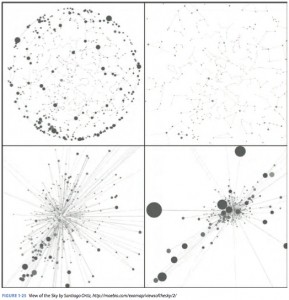 Figure i-25
Without context, information is useless, and any visualization you create with information technology volition as well be useless. Using data without knowing anything about information technology, other than the values themselves, is like hearing an abridged quote secondhand so citing it equally a chief discussion point in an essay. It might exist okay, but you gamble finding out later that the speaker meant the reverse of what yous thought.
You have to know the who, what, when, where, why, and how — the metadata, or the information well-nigh the information — before you can know what the numbers are actually nigh.
Who: A quote in a major newspaper carries more weight than i from a celebrity gossip site that has a reputation for stretching the truth. Similarly, data from a reputable source typically implies amend accuracy than a random online poll.
For example, Gallup, which has measured public stance since the 1930s, is more reliable than say, someone (for instance, me) experimenting with a small, one-off Twitter sample late at night during a curt menses of time. Whereas the former works to create samples representative of a region, there are unknowns with the latter.
Speaking of which, in addition to who collected the data, who the data is about is as well important. Going dorsum to the gumballs, it's often not financially feasible to collect data nearly anybody or everything in a population. Most people don't take fourth dimension to count and categorize a thousand gumballs, much less a million, so they sample. The primal is to sample evenly beyond the population so that it is representative of the whole. Did the data collectors practice that?
How: People ofttimes skip methodology because it tends to be complex and for a technical audience, just it'due south worth getting to know the gist of how the data of interest was nerveless.
If you're the one who collected the data, and then yous're good to become, but when y'all grab a dataset online, provided past someone you've never met, how will y'all know if it's any good? Do you trust information technology correct abroad, or practice you investigate? Yous don't take to know the exact statistical model backside every dataset, just look out for small samples, high margins of error, and unfit assumptions about the subjects, such as indices or rankings that incorporate spotty or unrelated data.
Sometimes people generate indices to measure out the quality of life in countries, and a metric like literacy is used as a factor. Nonetheless, a land might not have upwardly-to-date information on literacy, and then the data gatherer simply uses an gauge from a decade earlier. That's going to cause issues considering so the index works merely nether the supposition that the literacy rate one decade earlier is comparable to the present, which might not be (and probably isn't) the case.
What:Ultimately, you desire to know what your data is about, only before yous can exercise that, you should know what surrounds the numbers. Talk to subject area experts, read papers, and report accompanying documentation.
In introduction statistics courses, yous typically learn about analysis methods, such as hypothesis testing, regression, and modeling, in a vacuum, because the goal is to learn the math and concepts. Just when yous become to existent-earth data, the goal shifts to data gathering. Y'all shift from, "What is in the numbers?" to "What does the information represent in the world; does it make sense; and how does this relate to other data?"
A major fault is to treat every dataset the same and use the same canned methods and tools. Don't do that.
When: Near information is linked to fourth dimension in some way in that it might be a time serial, or it'due south a snapshot from a specific flow. In both cases, you take to know when the data was collected. An estimate made decades ago does not equate to one in the present. This seems obvious, but it's a common fault to take onetime data and pass it off equally new because it's what's available. Things change, people alter, and places change, so naturally, data changes.
Where: Things can change across cities, states, and countries simply as they do over time. For instance, it's best to avoid global generalizations when the data comes from just a few countries. The aforementioned logic applies to digital locations. Data from websites, such as Twitter or Facebook, encapsulates the behavior of its users and doesn't necessarily translate to the physical world.
Although the gap between digital and concrete continues to shrink, the space between is still evident. For instance, an animated map that represented the "history of the world" based on geotagged Wikipedia, showed popping dots for each entry, in a geographic space. The finish of the video is shown in Effigy 1-26.
The result is impressive, and there is a correlation to the existent-life timeline for certain, but it's clear that because Wikipedia content is more than prominent in English-speaking countries the map shows more than in those areas than anywhere else.
Why: Finally, you must know the reason data was collected, by and large as a sanity cheque for bias. Sometimes data is nerveless, or even fabricated, to serve an calendar, and y'all should be wary of these cases. Government and elections might be the commencement thing that come to mind, just so-called information graphics effectually the web, filled with keywords and published by sites trying to take hold of Google juice, have also grown up to be a mutual culprit. (I barbarous for these a couple of times in my early days of blogging for FlowingData, just I learned my lesson.)
Learn all you lot tin about your data before anything else, and your analysis and visualization will exist amend for information technology. You can so laissez passer what you know on to readers.
Figure 1-26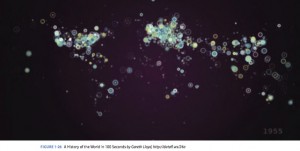
Withal, just because you take data doesn't hateful you lot should make a graphic and share it with the earth. Context can help you add a dimension — a layer of information — to your data graphics, but sometimes it means information technology'southward better to hold back because it's the right thing to do.
In 2010, Gawker Media, which runs large blogs like Lifehacker and Gizmodo, was hacked, and 1.3 1000000 usernames and passwords were leaked. They were downloadable via BitTorrent. The passwords were encrypted, but the hackers cracked about 188,000 of them, which exposed more than 91,000 unique passwords. What would y'all practise with that kind of information?
The hateful thing to practise would be to highlight usernames with common (read that poor) passwords, or you could go so far equally to create an application that guessed passwords, given a username.
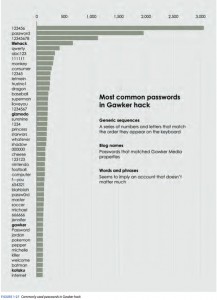
A different road might be to highlight simply the mutual passwords, as shown in Effigy i-27. This offers some insight into the data without making information technology also like shooting fish in a barrel to log in with someone else'southward business relationship. It might also serve every bit a alert to others to modify their passwords to something less obvious. You know, something with at least two symbols, a digit, and a mix of lowercase and uppercase letters. Countersign rules are ridiculous these days. But I digress.
Effigy 1-27
With data like the Gawker set, a deep analysis might be interesting, but information technology could besides practice more than damage than good. In this example, data privacy is more important, then it'southward better to limit what yous show and look at.
 Whether you should use data is not always articulate-cut though. Sometimes, the split between what's right and wrong can be gray, and so it's upwardly to you to brand the call. For example, on October 22, 2010, Wikileaks, an online system that releases private documents and media from anonymous sources, released 391,832 United states Ground forces field reports, at present known as the Iraq State of war Logs. The reports recorded 66,081 civilian deaths out of 109,000 recorded deaths, between 2004 and 2009.
The leak exposed incidents of abuse and erroneous reporting, such as noncombatant deaths classified as "enemy killed in activity." On the other hand, it can seem unjustified to publish findings about classified data obtained through less than savory means.
Maybe in that location should be a golden rule for data: Treat others' information the style you would desire your data treated.
In the end, it comes dorsum to what data represents. Data is an abstraction of existent life, and existent life can be complicated, only if you get together enough context, you lot tin can at to the lowest degree put forth a solid effort to make sense of it.
Excerpted with permission from the publisher, Wiley, from Information Points: Visualization That Means Something by Nathan Yau . Copyright © 2013
Author Bio
Nathan Yau, author ofData Points: Visualization That Ways Something,has a PhD in statistics and is a statistical consultant who helps clients brand use of their information through visualization. He created the popular site FlowingData.com, and is the writer ofVisualize This: The FlowingData Guide to Design, Visualization, and Statistics, also published past Wiley.
For more information delight visit http://flowingdata.com, and follow the author on Facebook and Twitter
barrewasheigandis.blogspot.com
Source: https://www.questionpro.com/blog/understanding-data-context/
0 Response to "what word means killing something to create something better"
Postar um comentário